Friday, November 25, 2005

Slavery in the ancient Greek world

This posting has not much to do with Philo research as such, but with research on ancient slavery, a field that I am very interested in (cf. The Philemon letter in the New Testament), and it is thus relevant for New Testament research, and- also for the study of Diaspora Judaism. I just came over a review of R. Zelnick-Abramovitz,
Not Wholly Free: The Concept of Manumission and
the Status of Manumitted Slaves in the Ancient Greek World.
Mnemosyne Supplement 266. Leiden: Brill, 2005. Pp. viii, 392. ISBN
90-04-14585-0. $160.00.

Reviewed by Deborah Kamen, Stanford University (dkamen@stanford.edu)
. The review can be read on BrynMawr Classical Review.

What also struck me here as very interesting, is that the reviewer points to another project on slavery inscriptions by Elisabeth Meyer:"A New Interpretive Study of Slavery in Hellenistic and Roman Greece." The project is presented thus: "he overall long-term goal of this project is to create an electronic archive of all Greek manumission inscriptions that can be of use to epigraphists (scholars specializing in the study of ancient inscriptions) and historians (of antiquity, but also of slavery in other historical periods) alike. The project was initially conceived as a way of organizing one type of data on which my own study of slavery, manumission, freedman status, and inscribing habits in Greece during the Hellenstic and Roman periods would be based, but has rapidly become more technically oriented and more precise, since all work which uses inscriptions needs to reflect a high degree of care and accuracy. The project thus aims to satisfy the needs of Greek epigraphists, to the extent that they can be satisfied when they cannot work from the stones themselves, by providing high-quality color images (and details) of every inscription, complete physical descriptions, comprehensive references to previous readings of the texts, reliable information about where the stone can now be found, and Greek texts of my reading of the stones. But I would also like to make this material accessible to non-epigraphists, and indeed to non-classicists (e.g. students of slavery in other historical periods), and have therefore included English translations of all inscriptions in this archive, information about location and context when possible, and forms of tagging (e.g. to price) that will help non-specialists to gather information from this archive."

You can here browse the inscriptions (a search function, alas, did not work for me).
A tremendous help when investigating ancient slavery; internett at its best!

Thursday, November 24, 2005

On De Virtutibus

On Tuesday, the last day of the SBL Annual Meeting, I attended the second Philo session, and for me, it was the most rewarding one. And do you know what: two out of three used handouts!! (cf. my former posting below..)


Here you see the participants: Walter Wilson is presenting his paper, while Davit T. Runia (who presided at the session), then David Konstan, Gregory E. Sterling, and James R. Royse.

The theme was Interpreting Philo’s De Virtutibus.

First out was
Walter Wilson, Emory University, who is writing the commentary on De Virtutibus in Philo of Alexandria Commentary Series (PACS). His paper was an interesting discussion of some aspects relating to work, and he in particular dealt with issues raised by Katell Bertholot, Philanthropia Judaica: le debat autour de la "misanthropie" des lois juives dans l'antiquite (JSJ 76; Leiden: E.J. Brill 2003, sorry for the missing accents in my printing of the title here..TS)), and then with Emilio Gabba, 'Studi su Dionigi da Alicarnasso: La costituzione di Romolo,' Athenaeum 38 (1960) 175-225,
Gregory E. Sterling, University of Notre Dame, was respondent to this paper

James R. Royse, (San Francisco State University) gave his paper on The Text of Philo’s De Virtutibus. He even handed out his whole manuscript. Great! This paper was also illuminating to me as I do not know very much about issues related to the text and various manuscripts of Philo's work.

Last presenter was David Konstan (Brown University), whos paper was on Philo’s De Virtutibus in the Perspective of Greco-Roman Philosophical Literature. I would have liked very much to have had some handouts of this too, as I found it very interesting; but here I'll probably have to wait for its publication.

After the session I was having lunch at Maggiano's Little Italy restaurant, with Jutta Leonhardt-Balzer, Ellen Birnbaum and David M. Hay. A very very pleasant closing of this years SBL Annual Meeting.

Monday, November 21, 2005

Philo and Qumran


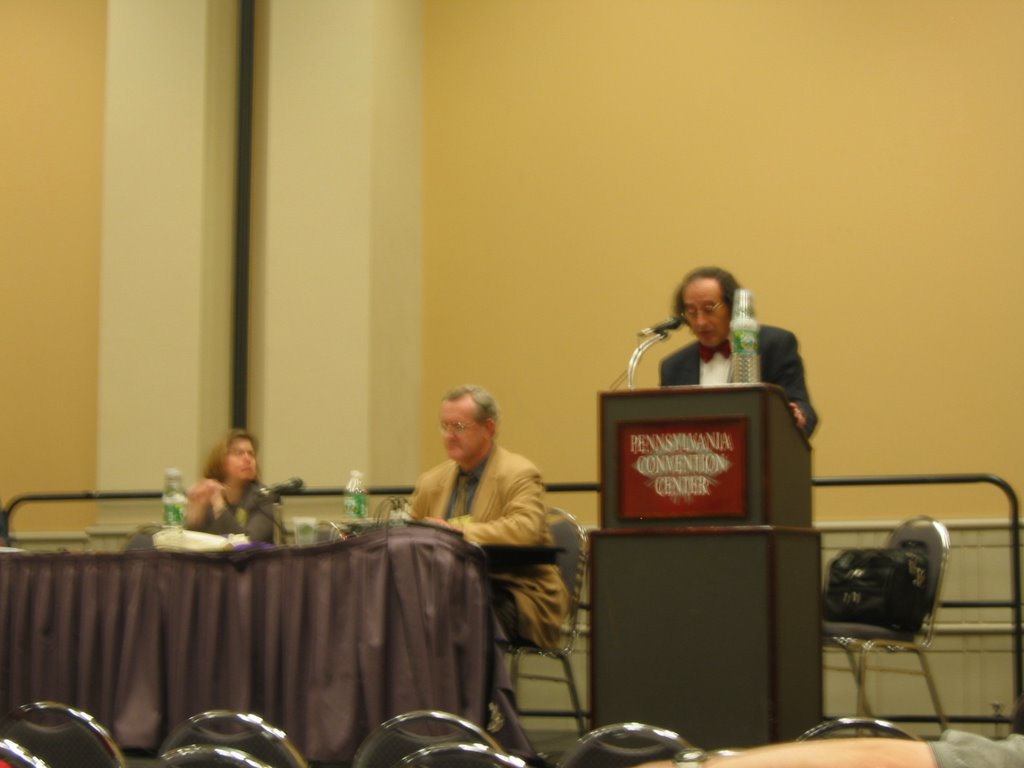
This morning I attended the first session of two sessions on Philo:On the not too good picture above you can see Martinez lecturing, while Collins and Najman are attentive listeners.


Philo of Alexandria

9:00 AM to 11:30 AM
Room: Room 103-B - Pennsylvania Convention Center
Theme: Linguistic Border Crossing: Philo of Alexandria and the Dead Sea Scrolls
John Collins, Yale University, Presiding
Florentino Garcia Martinez, Katholieke Universiteit Leuven
Divine Sonship at Qumran and in Philo (30 min)
Hindy Najman, University of Toronto
Revelation in the Desert: The Case of the Therapeutae and the Essenes (30 min)
Loren T. Stuckenbruck, University of Durham
To What Extent Did Philo's Treatment of Enoch and the Giants Presuppose a Knowledge of the Enoch-related Sources Preserved in the Dead Sea Scrolls (30 min)

It was certainly interesting to here and see F. Garzia Martinez, this expert on the Qumran Scrolls, and I do think he demonstrated his mastery of the sources in this lecture. The other two were also interesting, and I do hope all three papers will be printed in the next volume of Studia Philonica.

The English of Martinez was sometimes somewhat difficult to follow, and Najman, who is an excellent scholar, is also an impresssive fast speaker, adding explanatory parantheses along the way. I must admit, however, not having English as my mother tongue, that I would have been greatly helped if there had been some handouts, giving the main aspects of the arguments presented. This is not something experienced only in this session; by no way,- many presentations suffer in a similar way. But that is no excuse. Please; do start considering using handouts.
Hence I have to wait some time to have a fuller understanding and enjoyment of these important papers.

Those who have followed the biblioblogs for some times, will perhaps remember that similar comments of mine sparked a debate among bibliobloggers last year. The viwpoints offered then, can be reread here, and here and here..
Most of them are still valid.

Update Nov 25:
Mark Goodacre supports my plea for the use of handouts.

The Jews of Rome

I attended the session S20-62 Hellenistic Judaism, at the SBL Annual Meeting today; the most interesting paper for my part was Erich S. Gruen, The Jews at Rome: Alienation, Toleration or integration? or None of the Above?

He said discussions were often marred by the issues of ghettoization or assimilation as the most relevant options, but he claimed that the Jews where able to live at both of these two ends at the same time. Their situations were complex, but our sources seem to support the hypothesis that they clung to their distinction as Jews, while at the same time enjoying participation in the life of Rome.

Are we often thinking too much in dichotomies?

Sunday, November 20, 2005

Biblioblogging session over

Well, by now the biblioblogging session is over. I think the best part was the papers presented, but it was also interesting to meet the real persons behind the various names and pseudonyms so well known from their blog pages.
The discussion had its merits; it could perhaps, at least according to my opinion, have been a little more organised as people just 'took the word' and spoke without waiting in line, or giving a sign.
I had also hoped that someone (in addition to me.......:-) had focused a little more on the future; What do we expect blogosphere will look like in two years, and/or what do we want it to look like? I presume the wild flowers will continue to grow; but if we do not get more blogs who focus more strictly on specific fields, or groups of biblical writings, we will lose some interest in the scholarly world....
That's my prophecy for the day....

Here is
a list of those commenting on the Biblioblogging session.

Saturday, November 19, 2005

BiblioBlogging issues

Some readers of this blog may have discovered that there will be a special session at the SBL Annual Meeting devoted to Biblioblogging. If not, you can read more about it here.

This event is not supposed to be focusing on Philo of Alexandria, but he will surely be mentioned, as I am one of the bloggers to participate in the discussion panel. I don't know how much time each of us will get in the discussion, and as I am not one of those fast-speaking-native-firstlanguage-English speakers, but a slow speaking Norwegian, I'll post some of my ideas about the future of Bibioblogging here. You are welcome to add your comments in the comment field below.

I was first a little surprised by being counted among the bibliobloggers and invited to this panel. On second thoughts, however, My Philo of Alexandria blog certainly deals with matter closely related to the study of the Bible as Philo himself was an expositor of the Scriptures, and his works are interesting for just that same reason.

My own blog came into being in relation to my Resource Pages for Biblical studies. The PaleoJudaica blog had been on the web for some time, and so had the New Testament Gateway blog, and a few others. I planned my Philoblog to be a place where I could present and discuss issues relevant in the world of Philo studies, and to gather and present material on the web on Philo. My first aim has been only partially fulfilled; there has been little discussion. After some time it became more and more a blog of collecting and presenting relevant links and news from the ongoing Philo research, both printed matter and websites.

There are several reasons for this; the main reason however, being my lack of time for just these things. Hence I focused more and more on updating it as a channel for presenting news in the fields of philonic studies. I try not to post on my personal life; I have two other blogs dealing with that (you can find them on my homepage), and I certainly do not write about Zwingli, but I focus on Philo and related issues within New Testament research.

Furthermore, I will not try to define what is or who is a biblioblogger. I do think the name just is there, and it needs no clear-cut definition. What I would like to focus on is some of the issues related to keeping and managing such a blog, and what I would like to see in the future.

The blogs now included among the 'biblioblogs' are very varied; the only common denominator seem to be that they in some ways deals with issues related to the Bible. Some are more academic than others, some are often rather personal diary-like. I will presume these aspects receive various responses from the readers. I made a little test among my colleagues in Stavanger at my present institution. I gave them a list of those blogs represented here in this panel, and asked them to have a look at, and – if possible - to tell me what they thought about the phenomenon of blogging, and what they would like to find. The answers I received varied from a confused professor asking: “What is a blog” to more informed responses. These latter focused on the scholarly content and thus usefulness of reading them, and explicitly said that postings of a more private nature would keep them away from visiting these sites. I am asking myself this: is our willingness and even interest in reading about personal experiences due to the fact that several of us have a feeling of knowing each other so much that it become natural to also read about personal issues and family events? If a blog is presented as scholarly, and not of the diary kind, I think we should be more restrictive here.

I do think some of the issues worthy of further discussion are closely related to something I brought up quite early on my blog concerning the keeping of comprehensive websites as, for instance, the New Testament Gateway and my own Resource Pages for Biblical Studies. At that time I called them megasites (see more on the discussion here). The fields of studies comprised by these sites, and the amount of studies published are so vast that it is becoming impossible for one person to be updated on all parts of, for instance in my case, Philonic and New Testament studies.
Hence I made two suggestions, and these, I think, are quite relevant also for the future of effective biblioblogging:
1. I would like to have more discussions of the prospects and problems of establishing a range of scholarly weblogs that deal seriously with various sections of the field of biblical studies and related fields.The focus of the megasites, or as here; the blogs, should be narrowed down from the comprehensive Biblical, Old - or New Testament to focus on individual Scriptures or group of scriptures. Good examples here are already the Evangelical Textual Criticism, Hypotyposeis, dealing with the Synoptic Gospels, the PastoralEpistles.com, dealing with the socalled Pastoral letters. But do we have any blogs dealing specifically with Old Testament groups of texts, or with the Pauline letters, the Johaninne writings, or the catholic epistles?(There might be some I don't know about yet; for those not mentioned here, please forgive me..)

It might be both possible and interesting – for the time being - to run and to read blogs that are biblical focused in such a wide way that they comprise not only biblical studies, but also biblical related movies, personal travels, and inputs from Zwingli. But not, I am afraid, in the long run. I would predict that those running such comprehensive blogs will sooner or later have to (re)consider narrowing their focus or splitting up their blogs into several. Some have already done that.

2. Secondly, I would like to see more blogs not only having a more narrow focus, but also to be run by several bloggers. I do have a co-blogger on my Philo blog; unfortunately he has not been able to be as active as we both wanted. And I would like to have others joining me. Some of the new blogs mentioned above, in fact, have several bloggers. And I do think that is something that will prove itself rewarding.

The blogs are here to stay. But if they shall continue to gather interest from the scholars around the world who do not know the bloggers, and don’t want to know too much about them personally, but of their research the blog should be more narrow, and be driven by several bloggers in companionship.

I hope I am not killing the interest in the varity of Bible related blogs as we have it today. Let the wild flowers blossom! But for the sake of the future; let us also consider if there could be some more co-ordination among some bloggers, and thus be more able to build up a handful of biblical blogs focusing strictly on the scholarly research of the Old and New Testaments and related fields. It is not a question of either- or. We need both.

Nickelsburg, Jewish Literature

I spent a lot of time at the book exhibition today, and spent some money. There are a tremendous lot of new books publishe, and several revised editions are presented. Among some of the revised editions of useful books are the new edition ofGeorge Nickelsburg,
Jewish Literature between the Bible and the Mishnah, with CD-ROM
Fortress Press, 450 pages 6 x 9 inches
This version also includes some additional material, including now a chapter on Philo of Alexandria, and Josephus. Good to see Philo included where he belongs.
The list of the contents of the book can be seen here.

Philo on Gorgias Press

As mentioned by my co-blogger Kåre Fuglseth some weeks ago the Gorgias Press is to publish a complete Philo Concordance as a KWIC (Key-word in context) concordance.

Now they are announcing it on their website: "This edition, The Complete Works of Philo of Alexandria: A Key-Word-In-Context Concordance, is the ultimate printed form for any concordance with every occurrence of all Greek words. Each lemma is alphabetically ordered and presented within its context and thus designed to aid with research on Philo of Alexandria."

Skarsten, Peder Borgen, Kåre Fuglseth, Roald . The Complete Works of Philo of Alexandria: A Key-Word-In-Context Concordance
Gorgias Press. 7556pp; $ 1480
.


Gorgias is listed among the publishers present here at SBL; hence I will have to look them up, and see if they have some proof pages etc so one can get an impression of what the books will be like.