Someone may have missed that one can find some bibliographic information of the homepage of Studia Philonica:
Studia Philonica 1989-2000 volumes I-XII
Index of articles and bibliographies
arranged by author.
Index of Reviews, arranged by author:
Volumes I-XII, 1989-2000.
Every Issue of Studia Philonica contains now an extended annotated bibliography. These are then collected and published as a book every 10th year. In my next posting I will return to relevant bibliographies for the study of Philo.
By the way; have you located and marked your spot on the Philo of Alexandria Map? Go to http://www.frappr.com/philoofalexandriablog, then find and click on the link in the upper right corner, labelled Add Yourself. Thanks.
Wednesday, November 30, 2005

Bibliographics..
When you surf the Internet, you find something new, something old; this time I found something old, but nevertheless new to me!
It's a reference to an article of David T Runia I have missed to see before:Runia, David T. "The Idea and the Reality of the City in the Thought of Philo of Alexandria"
Journal of the History of Ideas - Volume 61, Number 3, July 2000, pp. 361-379
An excerpt of the article is given thus:
"The theme of my paper is the conception of the city as a social and cultural phenomenon held by the Jewish exegete and philosopher Philo of Alexandria (15 bc to 50 ad). There can be no doubt that the city occupied a central position in his own life. As an inhabitant of Alexandria he was thoroughly immersed in a highly urbanized form of life. From a more theoretical angle the city has an important place in his thought because of what it represents: of all physical products of human activity the city is the largest and most complex (here there is in fact little difference between Philo and us, although there is an obvious difference in scale). It is not my aim to examine Philo's political philosophy, i.e., his views on how the city should be governed, nor his views on the actual political administration of the Roman Empire in his time. These subjects have already been treated with sufficient competence by others. 1 I will argue that, though as an Alexandrian Philo was very much a homo urbanus, he nevertheless reveals a significant ambivalence towards the city. This attitude is related to his dual ideological background (Jewish and Greek), and anticipates developments in later antiquity."
It's a reference to an article of David T Runia I have missed to see before:
Journal of the History of Ideas - Volume 61, Number 3, July 2000, pp. 361-379
An excerpt of the article is given thus:
"The theme of my paper is the conception of the city as a social and cultural phenomenon held by the Jewish exegete and philosopher Philo of Alexandria (15 bc to 50 ad). There can be no doubt that the city occupied a central position in his own life. As an inhabitant of Alexandria he was thoroughly immersed in a highly urbanized form of life. From a more theoretical angle the city has an important place in his thought because of what it represents: of all physical products of human activity the city is the largest and most complex (here there is in fact little difference between Philo and us, although there is an obvious difference in scale). It is not my aim to examine Philo's political philosophy, i.e., his views on how the city should be governed, nor his views on the actual political administration of the Roman Empire in his time. These subjects have already been treated with sufficient competence by others. 1 I will argue that, though as an Alexandrian Philo was very much a homo urbanus, he nevertheless reveals a significant ambivalence towards the city. This attitude is related to his dual ideological background (Jewish and Greek), and anticipates developments in later antiquity."
Monday, November 28, 2005
Where do you live?
Due to a brief note on the Logos Bible Software Blog I was made aware of the interesting service of Frappr!, a free service providing the possibilities of setting up a map, and invite all visitors to place themselves on the map.
You can find the Philo of Alexandria map here: http://www.frappr.com/philoofalexandriablog
Please consider entering it and locate yourself on the map: you can also post a brief message and /or photo of yourself (visitors: click on the symbol to see the message). It would be interesting for both me and all other visitors to see where in the world the various PhiloBlog visitors live.
You can find the Philo of Alexandria map here: http://www.frappr.com/philoofalexandriablog
Please consider entering it and locate yourself on the map: you can also post a brief message and /or photo of yourself (visitors: click on the symbol to see the message). It would be interesting for both me and all other visitors to see where in the world the various PhiloBlog visitors live.
Friday, November 25, 2005
Slavery in the ancient Greek world
This posting has not much to do with Philo research as such, but with research on ancient slavery, a field that I am very interested in (cf. The Philemon letter in the New Testament), and it is thus relevant for New Testament research, and- also for the study of Diaspora Judaism. I just came over a review of R. Zelnick-Abramovitz,
Not Wholly Free: The Concept of Manumission and
the Status of Manumitted Slaves in the Ancient Greek World.
Mnemosyne Supplement 266. Leiden: Brill, 2005. Pp. viii, 392. ISBN
90-04-14585-0. $160.00.
Reviewed by Deborah Kamen, Stanford University (dkamen@stanford.edu) . The review can be read on BrynMawr Classical Review.
What also struck me here as very interesting, is that the reviewer points to another project on slavery inscriptions by Elisabeth Meyer:"A New Interpretive Study of Slavery in Hellenistic and Roman Greece." The project is presented thus: "he overall long-term goal of this project is to create an electronic archive of all Greek manumission inscriptions that can be of use to epigraphists (scholars specializing in the study of ancient inscriptions) and historians (of antiquity, but also of slavery in other historical periods) alike. The project was initially conceived as a way of organizing one type of data on which my own study of slavery, manumission, freedman status, and inscribing habits in Greece during the Hellenstic and Roman periods would be based, but has rapidly become more technically oriented and more precise, since all work which uses inscriptions needs to reflect a high degree of care and accuracy. The project thus aims to satisfy the needs of Greek epigraphists, to the extent that they can be satisfied when they cannot work from the stones themselves, by providing high-quality color images (and details) of every inscription, complete physical descriptions, comprehensive references to previous readings of the texts, reliable information about where the stone can now be found, and Greek texts of my reading of the stones. But I would also like to make this material accessible to non-epigraphists, and indeed to non-classicists (e.g. students of slavery in other historical periods), and have therefore included English translations of all inscriptions in this archive, information about location and context when possible, and forms of tagging (e.g. to price) that will help non-specialists to gather information from this archive."
You can here browse the inscriptions (a search function, alas, did not work for me).
A tremendous help when investigating ancient slavery; internett at its best!
Not Wholly Free: The Concept of Manumission and
the Status of Manumitted Slaves in the Ancient Greek World.
Mnemosyne Supplement 266. Leiden: Brill, 2005. Pp. viii, 392. ISBN
90-04-14585-0. $160.00.
Reviewed by Deborah Kamen, Stanford University (dkamen@stanford.edu)
What also struck me here as very interesting, is that the reviewer points to another project on slavery inscriptions by Elisabeth Meyer:
You can here browse the inscriptions (a search function, alas, did not work for me).
A tremendous help when investigating ancient slavery; internett at its best!
Thursday, November 24, 2005
On De Virtutibus
On Tuesday, the last day of the SBL Annual Meeting, I attended the second Philo session, and for me, it was the most rewarding one. And do you know what: two out of three used handouts!! (cf. my former posting below..)
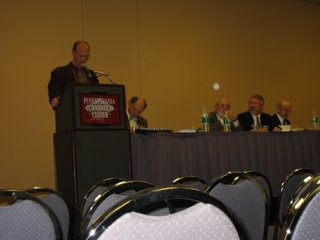
Here you see the participants: Walter Wilson is presenting his paper, while Davit T. Runia (who presided at the session), then David Konstan, Gregory E. Sterling, and James R. Royse.
The theme was Interpreting Philo’s De Virtutibus.
First out was Walter Wilson, Emory University, who is writing the commentary on De Virtutibus in Philo of Alexandria Commentary Series (PACS). His paper was an interesting discussion of some aspects relating to work, and he in particular dealt with issues raised by Katell Bertholot, Philanthropia Judaica: le debat autour de la "misanthropie" des lois juives dans l'antiquite (JSJ 76; Leiden: E.J. Brill 2003, sorry for the missing accents in my printing of the title here..TS)), and then with Emilio Gabba, 'Studi su Dionigi da Alicarnasso: La costituzione di Romolo,' Athenaeum 38 (1960) 175-225,
Gregory E. Sterling, University of Notre Dame, was respondent to this paper
James R. Royse, (San Francisco State University) gave his paper on The Text of Philo’s De Virtutibus. He even handed out his whole manuscript. Great! This paper was also illuminating to me as I do not know very much about issues related to the text and various manuscripts of Philo's work.
Last presenter was David Konstan (Brown University), whos paper was on Philo’s De Virtutibus in the Perspective of Greco-Roman Philosophical Literature. I would have liked very much to have had some handouts of this too, as I found it very interesting; but here I'll probably have to wait for its publication.
After the session I was having lunch at Maggiano's Little Italy restaurant, with Jutta Leonhardt-Balzer, Ellen Birnbaum and David M. Hay. A very very pleasant closing of this years SBL Annual Meeting.

Here you see the participants: Walter Wilson is presenting his paper, while Davit T. Runia (who presided at the session), then David Konstan, Gregory E. Sterling, and James R. Royse.
The theme was Interpreting Philo’s De Virtutibus.
First out was Walter Wilson, Emory University, who is writing the commentary on De Virtutibus in Philo of Alexandria Commentary Series (PACS). His paper was an interesting discussion of some aspects relating to work, and he in particular dealt with issues raised by Katell Bertholot, Philanthropia Judaica: le debat autour de la "misanthropie" des lois juives dans l'antiquite (JSJ 76; Leiden: E.J. Brill 2003, sorry for the missing accents in my printing of the title here..TS)), and then with Emilio Gabba, 'Studi su Dionigi da Alicarnasso: La costituzione di Romolo,' Athenaeum 38 (1960) 175-225,
Gregory E. Sterling, University of Notre Dame, was respondent to this paper
James R. Royse, (San Francisco State University) gave his paper on The Text of Philo’s De Virtutibus. He even handed out his whole manuscript. Great! This paper was also illuminating to me as I do not know very much about issues related to the text and various manuscripts of Philo's work.
Last presenter was David Konstan (Brown University), whos paper was on Philo’s De Virtutibus in the Perspective of Greco-Roman Philosophical Literature. I would have liked very much to have had some handouts of this too, as I found it very interesting; but here I'll probably have to wait for its publication.
After the session I was having lunch at Maggiano's Little Italy restaurant, with Jutta Leonhardt-Balzer, Ellen Birnbaum and David M. Hay. A very very pleasant closing of this years SBL Annual Meeting.
Monday, November 21, 2005
Philo and Qumran
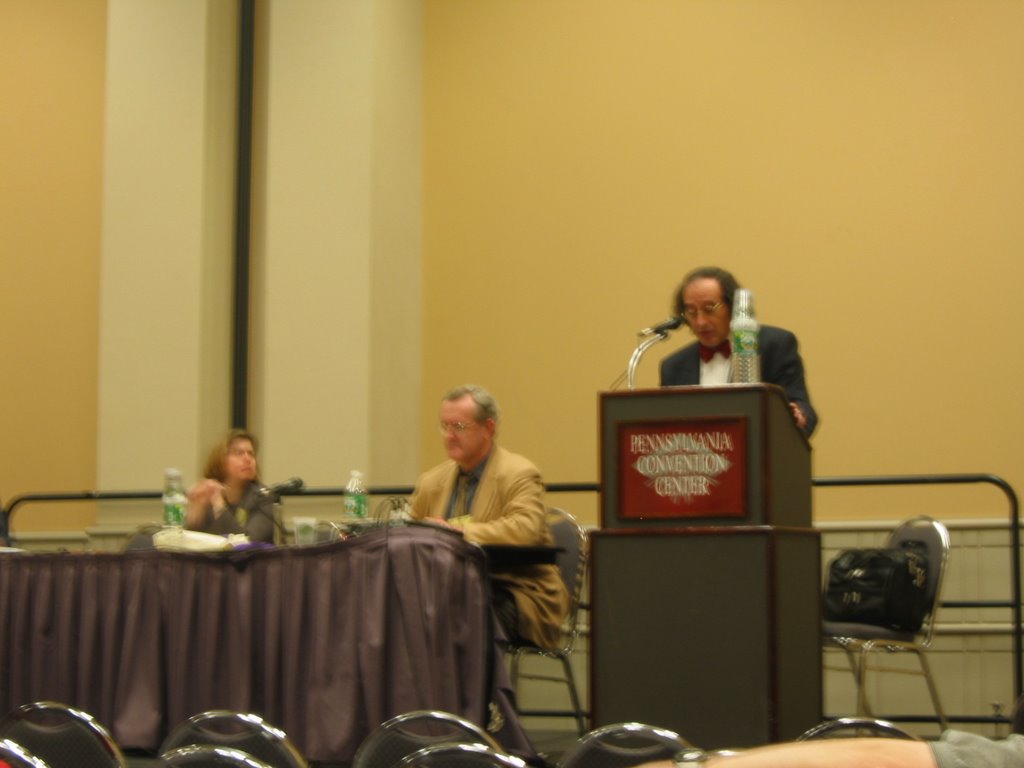
This morning I attended the first session of two sessions on Philo:On the not too good picture above you can see Martinez lecturing, while Collins and Najman are attentive listeners.
Philo of Alexandria
9:00 AM to 11:30 AM
Room: Room 103-B - Pennsylvania Convention Center
Theme: Linguistic Border Crossing: Philo of Alexandria and the Dead Sea Scrolls
John Collins, Yale University, Presiding
Florentino Garcia Martinez, Katholieke Universiteit Leuven
Divine Sonship at Qumran and in Philo (30 min)
Hindy Najman, University of Toronto
Revelation in the Desert: The Case of the Therapeutae and the Essenes (30 min)
Loren T. Stuckenbruck, University of Durham
To What Extent Did Philo's Treatment of Enoch and the Giants Presuppose a Knowledge of the Enoch-related Sources Preserved in the Dead Sea Scrolls (30 min)
It was certainly interesting to here and see F. Garzia Martinez, this expert on the Qumran Scrolls, and I do think he demonstrated his mastery of the sources in this lecture. The other two were also interesting, and I do hope all three papers will be printed in the next volume of Studia Philonica.
The English of Martinez was sometimes somewhat difficult to follow, and Najman, who is an excellent scholar, is also an impresssive fast speaker, adding explanatory parantheses along the way. I must admit, however, not having English as my mother tongue, that I would have been greatly helped if there had been some handouts, giving the main aspects of the arguments presented. This is not something experienced only in this session; by no way,- many presentations suffer in a similar way. But that is no excuse. Please; do start considering using handouts.
Hence I have to wait some time to have a fuller understanding and enjoyment of these important papers.
Those who have followed the biblioblogs for some times, will perhaps remember that similar comments of mine sparked a debate among bibliobloggers last year. The viwpoints offered then, can be reread here, and here and here..
Most of them are still valid.
Update Nov 25:
Mark Goodacre supports my plea for the use of handouts.
The Jews of Rome
I attended the session S20-62 Hellenistic Judaism, at the SBL Annual Meeting today; the most interesting paper for my part was Erich S. Gruen, The Jews at Rome: Alienation, Toleration or integration? or None of the Above?
He said discussions were often marred by the issues of ghettoization or assimilation as the most relevant options, but he claimed that the Jews where able to live at both of these two ends at the same time. Their situations were complex, but our sources seem to support the hypothesis that they clung to their distinction as Jews, while at the same time enjoying participation in the life of Rome.
Are we often thinking too much in dichotomies?
He said discussions were often marred by the issues of ghettoization or assimilation as the most relevant options, but he claimed that the Jews where able to live at both of these two ends at the same time. Their situations were complex, but our sources seem to support the hypothesis that they clung to their distinction as Jews, while at the same time enjoying participation in the life of Rome.
Are we often thinking too much in dichotomies?
Sunday, November 20, 2005
Biblioblogging session over
Well, by now the biblioblogging session is over. I think the best part was the papers presented, but it was also interesting to meet the real persons behind the various names and pseudonyms so well known from their blog pages.
The discussion had its merits; it could perhaps, at least according to my opinion, have been a little more organised as people just 'took the word' and spoke without waiting in line, or giving a sign.
I had also hoped that someone (in addition to me.......:-) had focused a little more on the future; What do we expect blogosphere will look like in two years, and/or what do we want it to look like? I presume the wild flowers will continue to grow; but if we do not get more blogs who focus more strictly on specific fields, or groups of biblical writings, we will lose some interest in the scholarly world....
That's my prophecy for the day....
Here is
a list of those commenting on the Biblioblogging session.
The discussion had its merits; it could perhaps, at least according to my opinion, have been a little more organised as people just 'took the word' and spoke without waiting in line, or giving a sign.
I had also hoped that someone (in addition to me.......:-) had focused a little more on the future; What do we expect blogosphere will look like in two years, and/or what do we want it to look like? I presume the wild flowers will continue to grow; but if we do not get more blogs who focus more strictly on specific fields, or groups of biblical writings, we will lose some interest in the scholarly world....
That's my prophecy for the day....
Here is
a list of those commenting on the Biblioblogging session.
Subscribe to:
Posts (Atom)


